Article by Richard McMurtry
The Santa Clara Valley Water District Board held a regular meeting on July 28th, and discussed efforts to restore the salmon and trout fisheries on Santa Clara County streams (see agenda packet, p 72). The end result was a step backwards from its commitments towards the salmonid restoration.
In a move with a short public notice (only 72 hours notice), Water District CEO Beau Goldie proposed to remove Chinook salmon from the fishery restoration strategy and replace it with native fish. Debate has raged in past years as to whether the Chinook salmon are native or not. So, in effect, the change replaced the previous strategy to “Restore the trout and salmon population” with an ambiguous “we won’t restore the salmon because we don’t know if they are native” or an even more ambiguous “maybe we will, maybe we won’t restore the salmon”. All the Board achieved is reigniting a controversy that had been thought settled in 2003.
A member of the Santa Clara Creeks Coalition implored them to not take the salmon out of the policy framework without first convening a science panel to consider the scientific data on whether the salmon were native or not. Despite this recommendation, the Board refused to reject the change proposed by the CEO and instead allowed the change to pass. However, the Board did express an interest in convening a science panel, but no member proposed a motion to do so. What is bizarre about this is that the Water Supply division has already agreed to develop a plan to restore the Chinook salmon population. The result is that the Board now has contradictory policies shaping its approach to salmon restoration – a contradiction that will generate ambivalence towards salmon restoration rather than the enthusiasm needed to develop innovative conservation measures for the salmon. Things at the Water District don’t bode well for the salmon.
Water District staff opposed all the recommendations of the Environmental and Water Resources Committee (EWRC) with respect to the Board recommitting to restoring the salmonid fishery within 15 years and preserving the fishery during drought. The Board mostly went along with staff recommendations. The only positive outcome was a watered-down version of the recommitment to the 15 year goal. In the Board-adopted version, staff would develop a strategy at some unknown point in the future. We will have to wait years for the CEO’s Master Planning process to reach completion with no independently facilitated technical input process. The best ideas will never even be presented to the Board.
The EWRC’s recommended drought policies sought to distinguish between “water needs” and “water preferences” – “needs” like health and safety and “preferences” like lawn watering. Staff opposed making this distinction, and the Board agreed. The EWRC recommended inserting an objective “Adequate quantity and quality of water will be delivered to the streams” to protect the fish and stream ecology. The Board refused to adopt this objective, instead referring it to the cities and water purveyors to see what those groups thought about the policy.
Showing posts with label fish. Show all posts
Showing posts with label fish. Show all posts
Friday, August 15, 2014

Wednesday, August 13, 2014
Stevens Creek Fishery: Restoration or Extirpation?
Article by Richard McMurtry
Stevens Creek was once one of our county’s streams with the best potential for restoration of a healthy abundant run of steelhead trout. Fishery biologists found adult steelhead as well as smolts (young fish headed to the sea). The Santa Clara Valley Water District had stated in 2003 a commitment to perform the necessary actions to create the habitats to restore the fish population to a healthy condition. Also as a result of a victorious pollution suit in 2013 against the Permanente Quarry in Cupertino, actions to improve habitat in upper Permanente Creek will be implemented in the next few years.
All this is well and good. But the Water District, facing a drought, decided to save water for lawn watering and other human needs by turning off the flow of water from the Stevens Creek pipeline into the creek. Any steelhead remaining in the creek were wiped out by the dryback and became food for raccoons and herons!
Stevens Creek was once one of our county’s streams with the best potential for restoration of a healthy abundant run of steelhead trout. Fishery biologists found adult steelhead as well as smolts (young fish headed to the sea). The Santa Clara Valley Water District had stated in 2003 a commitment to perform the necessary actions to create the habitats to restore the fish population to a healthy condition. Also as a result of a victorious pollution suit in 2013 against the Permanente Quarry in Cupertino, actions to improve habitat in upper Permanente Creek will be implemented in the next few years.
All these encouragements gave rise to the idea of finding ways that Stevens Creek steelhead could swim upstream and then get over to nearby Permanente Creek to spawn and rear their young. One option is to convert a flood water channel (that joins Permanente Creek to Stevens Creek) into a fish passage way to let fish go from Stevens Creek into spawning and rearing habitats in Permanente Creek.
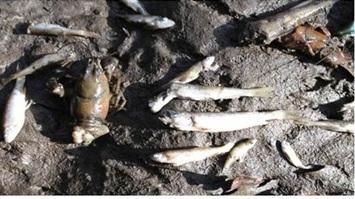 |
| Dead trout, minnows, crayfish in Stevens Creek |
There are two things that need to be done to protect and restore our steelhead.
- Remove the barriers to fish migrating from the Bay to the upper reaches of the stream to spawn and rear their young.
- Develop a fish rescue and relocation plan to move the steelhead to year-round reaches of the stream above the dam IF there is not enough water to keep the stream wet.
Subscribe to:
Posts (Atom)